Showing posts with label HHIR Interviews. Show all posts

Thursday, October 8, 2009

Punit Dhesi Interview, Pt. 2 | Behind the Lens


Continued from earlier in the week, here's part two of my conversation with music video director Punit Dhesi.


AM: How did you come up with the idea for Gangrene [Alchemist and Oh No]’s “Under Siege”?

PD: I had been talking to Alchemist a lot, we had been going back and forth. He really wanted to do something for the Gangrene [project], we talked about doing the “Therapy” video, just trying to make something happen. I went down there and stayed with him for two days. We were just sitting there and we came up with it together. We just started watching riot footage and it just came to us. I said, “Can we just put you guys in the riot footage?” I got this documentary done by ABC on the L.A. riots from the library on VHS and just ripped all the footage. Some of it is from YouTube too. I just studied it, trying to match the shots. We shot it all on green screen one day in downtown L.A.

Actually we had printed out some promo copies on VHS, with a cover and everything, and sent out 100 copies to press. My buddy Josh Harding does all the digital motion graphics and effects, I don’t deal with a lot of that. After we edited the whole video, we outputted it from the computer to a VHS tape and made four copies back and forth, so it was a fourth-generation copy. Then we sent it back into the computer. Some people commented, “Those are cool VHS filters you use” and this and that. We just made a bunch of copies of it on VHS, that was how we did it.

AM: Did Alc and Oh No bring their own wigs?

PD: No, I got them at some Korean wig shop. I went in there without much of a budget, I said we needed some wigs. This lady was telling me 200 dollars for a wig. I said no way, and I’m thinking, I don’t know if we’re going to get any wigs. So I thanked her and I bounced. I was in my car and I was leaving, she ran outside and she said, “Okay, okay, you want a wig?” And she pulled out this box full of wigs and she gave it to me for 10 dollars. Oh No has one that was a beard, but he was wearing it as a wig. [Laughs] Weird shit.


AM: Where did the idea for the “Life As A Shorty” video come from?

PD: The song itself set the tone. It was basically written for you. It felt like bright colors, school playgrounds. I wanted to do it that way because I loved the way that [Fashawn] made that song really lighthearted but the content is real. The videos I’ve done that I really like, they’ll play me a record and I just know I want to do the video. I can already see it. For “F.A.S.H.A.W.N.”, they just played me the record and I said, “Let’s do a video”. Same thing for “Our Way”, when I heard it. And it was the same way for “Life As A Shorty”. The first thing I saw in my head was the ice cream and the balloon. The first scene sets the tone for the rest of the video. It’s supposed to be a constant theme throughout it, with the bully. As soon as little Fashawn gets something in his life that he cares about, it gets taken away from him. From the ice cream to the balloon. The toy that his real father gives him, that’s a metaphor for his father coming into his life. He’s playing with the toy and it suddenly gets snatched away from him. He’s sad about the toy but really he’s sad about his father coming in and out of his life. When he tries to go up to the little girl on the playground and give her a little key chain and a bully steps in and ruins that for him. The girl he’s hanging out with, and another guy steps in the picture. There’s a constant theme that every time he gets something, it gets taken away, until finally, at the end of the video, the young Fashawn meets the old Fashawn. He’s sitting on the curb and [the old Fashawn] gives him the notebook. After all this, take this notebook because what you write, nobody can take that away from you.

AM: How do you make creative music videos on a budget without resorting to making the stereotypical “hood” video?

PD: Budgets are nice! I’d love to have one someday. [laughs] Sometimes I think that helps in a way, the minimal tools you have. A camera, two people helping me out, maybe some reflectors and a makeshift dolly. That’s kinda all we have. The only thing I can depend on to make the shots look good are the actual aesthetics. I don’t have all the fancy lights or effects so I have to focus on taking the bare minimum and making something dope with it. Just shooting the street, I’m not happy with that. And I won’t do it, if that’s all there is. I just shot another video for Strong Arm Steady. That’s another one that’s coming out real guerrilla, no permits.

AM: What’s the video about?

PD: The concept of the song is they’re talking about their guns but in the form of women. It’s a real L.A. type video. '64 Impalas, and [a model] is the metaphor for the gun, she’s dressed in black leather and wearing brass knuckles.

AM: Which directors inspire you?

PD: The big budget stuff doesn’t really concern me. I’m looking at people like Jason Goldwatch. He did the “Back Again” video for Dilated [Peoples], the “Mr. Slow Flow” video [for Evidence]. I remember when Rik Cordero’s videos started popping up. They’re doing the guerrilla low budget thing but they make it look dope. I’m inspired by them but I’m also competing with them in my head.

To see more of Punit's videos, check him out at Vimeo!

Tuesday, October 6, 2009

Punit Dhesi Interview, Pt. 1 | Behind the Lens


This is the first installment of what I hope will become a regular feature. Behind the Lens is a feature where I speak with contemporary music video directors about their work. You may know Punit Dhesi from his work with Fashawn and Evidence, or from his stellar video for Gangrene’s “Under Siege”. I had the pleasure of talking with the Fresno-based director last week.

AM: What made you decide to become a director?

PD: I think it kinda fell upon me, I really didn’t make a conscious decision to do it. I used to DJ…actually I was working as an engineer in a studio where Fashawn used to record at. I used to work for his manager, this guy Hecktik [Aren Hekimian] and I would engineer for him. At the same time, I knew a little about video stuff and I’d never done a music video yet. One day they needed to do a video and I was around. They said, “Do we know anyone who can do a video?” and I said, “Yeah, I know how to do it. We can do something.” Fashawn is 17, I’m 18. They had a camera and we just went out and did it. It wasn’t that great but it wasn’t do bad either. We just kept building. We did another one, one with Planet Asia and just kept getting better. More people started calling. Even up to the “Our Way” video with Evidence, we were just fucking around. I didn’t take [any] of that seriously at all. I definitely didn’t think we were going to be on TV. I won an award for that video [California State University’s Media Arts Festival for Best Music Video]. It took off more than I expected, and that’s when I said, “Okay, I could be doing this”.


AM: Is the video for “Sunny CA” a homage to Xzibit’s “What U See Is What U Get” ?

PD: It’s funny because for that video, we didn’t plan anything out. We made it up as we went. Before we even did it, Fashawn said, “We should do the ‘What U See Is What U Get’ type of thing”. And honestly I didn’t even remember that video. But I said, “Yeah”, and after we did it, I realized [“Sunny CA”] was like [“What U See...”]. The first location we shot was Fashawn coming out of the apartment. That was just the spot we met up at, we were going to meet up there and go somewhere else. And he ended up knowing someone in the apartment so we just decided to shoot there. And from there we made the whole thing up.

AM: What do you use to shoot and edit?

PD: The camera that I use is a Canon XHA1, a basic HD camera. I edit with Final Cut and my MacBook Pro. Those are my tools for the most part. The first video I shot with the camera was the Chuck Dimes video; before that I would just borrow cameras.


AM: The video for the Soul Assassins’ “Classical” has a really distinct, moody look to it. How did you achieve that?

PD: I used a lot of color correction on there, but it was all intentional. I had that vibe in my mind before I shot it. Afterwards it was just playing with the programs enough to find the colors I already imagined. There was a certain location I had, it was actually for a different video I was supposed to do. The song “Therapy” for Alchemist, with Evidence, Blu and Kid Cudi. That location and how I shot that video had a lot to do with the treatment that I wrote for “Therapy”. I recycled it and added the Chinese lion dancer to it. Actually the drumming part of that video, that’s me.


AM: Let’s talk about “The Far Left”. Why reference “Subterranean Homesick Blues” for an Evidence video?

PD: That was all Evidence. After we did the “Our Way” video, he liked the way it came out and he said, “Let’s do one for me”. This was me branching out, because until recently it was all just this association with Fashawn. I had a completely [different] idea in mind, but his album [The Layover] was coming out real soon. He hit me up on a Thursday and he needed to shoot the video in three days. And he needed the [video] back after seven days. We were talking, I was telling him my idea and he just cut me off. He said, “I got it! The Bob Dylan one makes sense. That’s what we’re doing.” I didn’t know what he was talking about for the longest time until he sent me the YouTube video. He sent it to me the night before we had to shoot. We stayed up all night with this guy, Aloy, from The Seventh Letter/MSK [an L.A. based graffiti crew], he’s a graphic designer. We showed up at Alchemist’s studio in Santa Monica with all the blank cards and we stayed up all night. [Aloy] drew up all the cards and when the sun came out, we went to Venice Beach and shot the video. As soon as we got back to Alchemist’s spot, I started dumping all the footage.

It was supposed to be one take, but for lack of rehearsal we couldn’t pull it all off in one take. Evidence’s part is all one take, but for Fash and Al, I cut up two different shots. It worked out alright, it was cool.

This is the first part of the interview. Stay tuned for the second half later this week.

Thursday, July 30, 2009

Don Cannon | HHIR Twitterview


Since you guys liked that short MC Hammer Twitterview, I figured we'd keep it rolling. It'd be easy to just chat on Twitter and leave it at that, but some discussions are worth posting on the blog too. This time I was able to have a quick chat with Philly-born producer/DJ Don Cannon who shared some thoughts on... Hip Hop Is Read! Check it out:
IvanRott: @DonCannon What it do, Cannon!? (Ivan from @HipHopIsRead)

DonCannon: @IvanRott YOOO!!!!

IvanRott: @DonCannon Much love on the Kobe/Jordan post :D I saw that while you were tweeting the text and was like "DAMN!" HA!

DonCannon: @IvanRott YEAH I FUCKS WIT YALL HEAVY

IvanRott: @DonCannon Humbled, man... for real!

DonCannon: @IvanRott NO DOUBT

IvanRott: @DonCannon What kinda stuff do u like from the site specifically? Sample sets :D ? I'm workin on a new Big Daddy Kane joint right now!

DonCannon: @IvanRott I LOVE THE SAMPLE SETS!

DonCannon: @IvanRott I BE GETTIN ALL THE TAPE DECK JOINTS FOR THE RADIO

IvanRott: @DonCannon Oh, word? Peep this: I'm working on a year end wrap up of the best samples from the decade, year by year! Should be major... *

DonCannon: @IvanRott YOU SHOULD DO A THROW BACK TAPE DECK WIT ALL THE OLD SCHOOL HIP HOP JOINTS

IvanRott: @DonCannon Damn U just gave me an idea. U know how the Tape Deck says 2009 on the bottom right? I should do one for each 80s/90s year.

DonCannon: @IvanRott YESSSSSSSS!

IvanRott: @DonCannon No doubt, should be hype!

IvanRott: @DonCannon Good talkin to ya man! STAY UP! Again, the support is appreciated :D
And there you have it! Don Cannon's also a fan of your favorite blog! :D

Follow Cannon on Twitter: http://twitter.com/DonCannon

Follow me on Twitter: http://twitter.com/IvanRott

Follow Hip Hop Is Read on Twitter: http://twitter.com/HipHopIsRead

* P.S. Be prepared! :D

Sunday, September 28, 2008

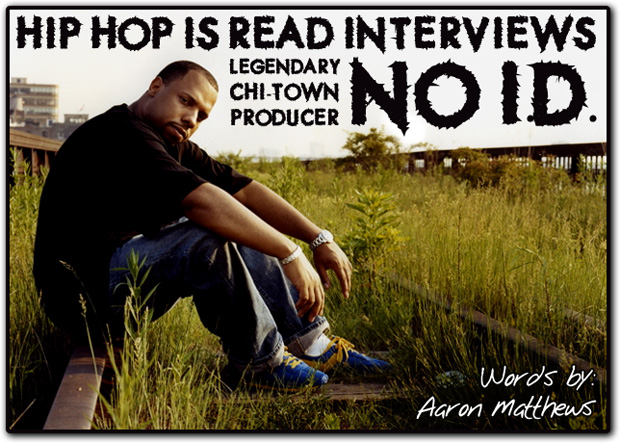
Hip Hop Is Read Interview with No I.D. (Part Two)


(Click Here for Part One!)
...
Aaron Matthews: Was Kanye actually hanging around the studio at this time? You mentioned him a little earlier.

No I.D.: Yeah, he was.

A.M.: Was he rapping yet or just studying your production?

I.D.: Naw, everything. When I met him, he was rapping and producing! He always was. I mean, he’d bring beats by all the time, be like, ‘Man, please, tell Common to let me do a beat for him.’ And it just... wasn’t the time, I’ll leave it at that! [laughs] But he definitely was around, and trying to contribute in every possible way.

A.M.: How did you originally meet him?

I.D.: His mom asked my mom, could I help him with music, and I kinda just did it as a favour. Like, ‘Okay, yeah, I know’. [laughs] It was over time that I saw him develop into what he is, even though I never could see that he would be all that he is.

A.M.: He had a group around that time, called The Go-Getters [consisting of Kanye, GLC and Really Doe].

I.D.: Yeah. There’s a lot of history to the whole thing. It’s a lot of it out there, there’s an album called World Record Holders. Kanye went through a lot of direction changes with his style. From doing beats like Puff, Jermaine, to doing beats like Timbaland until he really honed in where he wanted to go.

A.M.: Can you hear your influence on him?

I.D.: Yeah, definitely. That’s really how I describe it. I think I influenced him, but I’m not going to act like everything he does came from me. People say, you know, I taught him. And I’ll be around him, and he’ll introduce me to somebody and say, ‘He taught me everything I know.’ Nah. I probably gave him enough tools to learn the other things I didn’t teach him.

A.M.: Do you think there’s a Chicago sound? Around that time, there were a lot of people like yourself, Dug Infinite, Ynot and Kanye...

I.D.: There’s two Chicago sounds to me. I mean, you have the West Side sound and the South Side sound. I feel like I probably made the South Side sound and Traxster probably made the West Side sound, with Twista, Do Or Die, all of those. The South Side sound, in my eyes, is rooted in the house music. As a DJ, we would take parts of a record and repeat it, to give it an energy, and it would have parts that we really liked and we would call ‘em “pause mixes.” And just make these remixes of songs where certain parts repeat over and over. I feel like that’s where the Chicago sound originates, just comes to finding the best part of a record and making a whole song out of that. And just having it come from house music is what gave us our musical point of view where we look for melody and real musical instruments, versus just keyboards or artificial sounding instruments. And I think [Kanye] definitely got that from me.

A.M.: And you can hear that influence in recent records or even some of the stuff from the Go Getters’ days?

I.D.: Well, that’s what I mean. If you go back and listen to the Go Getters’ records, it’s left of that, maybe just some of that. Because he was experimenting with so many different styles. I mean, you’ll hear stuff that sounds like everybody. I think it wasn’t until me and Kyambo "Hip Hop" Joshua, we used to talk about Jay [Jay-Z] and I always used to tell him that Jay wasn’t going to go number one until he had a sound. And then that’s when Hip-Hop said, ‘Well, you know what? This new album, the sound's going to be soul.’ I remember Kanye said, ‘I’ma go back and study Resurrection, and Quest [A Tribe Called Quest], and the Pete Rock albums and really learn the soul all the way.’ And I remember him saying, ‘Okay, I got it now’. The point was, he always knew how to do everything. It was maybe around that Blueprint time that forced him to hone in on that sound, which made him recall everything I taught him in that lane and then learn other things that I had maybe learned from other people too. That’s where we kinda got the similar sound, from that type of working on the same project. I mean, you look at Just Blaze. Just Blaze did soul beats before that. When people talk about who has that sound and style, honestly, I feel like I was there. RZA had his sound, Premier had his sound, Quest [ATCQ] had their sound. But I feel like, back then, we didn’t all aim for a sound. We aimed for good music and it wasn’t about whether we kept a words sample in or not. It was just about what sounded good. It didn’t really come into that until we came into the “Marketing Age”, and people trying to say this person had that sound or whatever. I don’t think none of us purposefully did soul with voices until that was just the request of hip hop for Jay-Z.

A.M.: So it was kind of a conscious revival?

I.D.: Yeah. And once it really worked, that’s when everybody was like, ‘That’s it. We gotta do that’. But you know, I’ve still been doing what I do the whole time. If you listen to Can I Borrow A Dollar?, I was using voices and soul samples, speeding them up.

A.M.: You’ve been around for a long time too and I think a lot of that has to do with your ability to change your sound. So you had the records with Common that we talked about, East Coast sounding beats and later on you were doing stuff with Jay-Z. How did you originally hook up with Jermaine Dupri?

I.D.: I met him because the first [major] record that Kanye did and put out was with Jermaine Dupri [“Intro - Turn It Out” ft. Nas, off Life In 1472]. So I came down to the studio one time and met Jermaine and we had the same manager who used to work for Jermaine. And that’s how my relationship developed. It really wasn’t a working relationship at first, we were kinda just cool. Then one day, I just was like: Man, I feel like we had opposite styles. We should hook up, I’ll learn from him, he’ll learn from me. And we’ll do things that we wouldn’t normally do.

A.M.: "All Around the World" off The Blueprint² (The Gift & The Curse) was your first collabo with Jay. How did that come about?

I.D.: Kyambo "Hip Hop" Joshua was managing me for a stint, and he gave Jay a lot of beats. That’s just one of the songs that came out around then.

A.M.: Were you working in the studio with Jay for that one?

I.D.: That song came because I gave him some beats for The Blueprint that didn’t get to him in time. So when he started off, I think they told me that was the first song [Jay] did for The Blueprint² (The Gift & The Curse). That and some other beats, he stashed them away and pulled it up at the end of the album. He called me at the end of the album with two days left before mastering, like ‘Yo, this record...’ and I’m like, ‘Oookay’. [laughs] It was funny because he had time-stretched and chopped up my two track, and when I did that beat, my MPC had cut off when I was doing so I only had what I had tracked out. It was like a nightmare trying to fit the beat to what he did.

A.M.: Let me ask you about another record from around that time, Ghostface’s “Metal Lungies”. Another one of my favourite No I.D. beats.

I.D.: Aw, thanks. Me and Ghost got real cool for a period of time. I don’t even remember how he got the beats, but for that time period when I worked on those records, I was getting him a lot of beats, I was cool with his manager. And you know, Ghost was one of my favorites and Ghost was actually Hip Hop’s favourite rapper. It really was us connecting and having a lot of talk about hip-hop and the direction and where he was going. A lot of times, if I’m not really involved in a project, it’s just me giving them a beat and then having a song.

A.M.: Are you still tight with Ghost? Will there be any more No I.D./Ghostface collaborations?

I.D.: We not as tight but I love him as a rapper, so I’ll always want to do something.

A.M.: You’re based in Atlanta now. When did you move down there?

I.D.: I moved down... this is the 2nd time I’ve moved here. I moved down like 3 years ago for the 2nd time.

A.M.: How did you hook up with Killer Mike?

I.D.: Me and his manager are real cool. That’s how I met him. I used to go over to Purple Ribbon and he’d always be there. He’s one of my good friends. He’s probably one of the people I’ve met in the industry that I know I want to work with and do a whole project with. He wants to do a whole project with me and I really want to go back to that place of trying to make a classic album. We’re going to do a whole album together.

A.M.: All No I.D. production?

I.D.: Pretty much. If not, then me influencing the direction, me executive producing it. We also about to do a mixtape, me, him and [Don] Cannon.

A.M.: That sounds crazy, man. When is that coming out?

I.D.: We just started on the mixtape and we’ve been working on the album off and on. He just finished his independent album with SMC, I Pledge Allegiance To The Grind II. Now we going to get in and really get on it.

A.M.: What’s your current set-up in the studio in Atlanta?

I.D.: Me and a producer named LRoc who works with Lil’ Jon and Jermaine got a studio together. Now, I kinda use Logic, a computer program, and I don’t really need all of that. It’s like more of a real studio, ‘cause you can really go in there and really do records. I really do most of my beats on a laptop, honestly. So I don’t really have to have all of that to do a beat.

A.M.: So you work mostly with Logic these days?

I.D.: Yeah. And a bunch of plug-ins. I’m not going to act like I just use Logic.

A.M.: On a website I write for, Metal Lungies, we do this feature called the Beat Drop, where we pick a producer and we have a bunch of different writers and they pick their favourite beats by that producer. We did one on Kanye and we had people pick their favourite Kanye beats. I wanted to know if you had five favourite Kanye beats.

I.D.: It would be [Beanie Sigel]’s “The Truth”. His beat on the Madd Rapper [album Tell ‘Em Why You Mad] called “Ghetto”, a lot of people never heard. “Late”, off Late Registration. “Takeover” [Jay-Z].

A.M.: Was there early stuff that you really liked?

I.D.: Oh yeah. He got a lot of beats with an independent artist named Grav, [those] were the first beats he really produced on.

A.M.: Could you take me through the process of making a beat?

I.D.: Nowadays it either starts with me listening to records or having something in my head already. Either way, I kinda do beats in my head first, ‘cause I have to see the mistakes in the beat and fix them without having to go through the process and getting tired and worn out. A lot of it is just me listening and thinking, and really trying to envision what I want to hear and feel. That’s always my first step. A lot of people that work with me sometimes get frustrated because, it’ll look like I’m not doing nothing, I’m just sitting there, playing records and talking. They’re like, ‘C’mon, let’s work!’ and I’m like, ‘I’m working!’ And at that moment that I got it, I’ll do it quickly and it’ll be correct because I took enough time to really figure it out. A lot of people do a lot of beats and sometimes it’s just one little wrong thing with all of them and never take the time to fix ‘em. Me and Kanye always had a thing called problem solving, like he’ll play me a beat and be like, ‘Problem solve this’. And I’ll say what’s wrong and he’ll fix it. And after a while, you learn how to problem solve with yourself.

A.M.: Is that the same process when you co-produce?

I.D.: Me and Jermaine’s process is different. Usually he’ll have the vision and usually he’ll call me to bring about a vision he don’t know how to bring about. It’s a little easier. I’d say my perspective and vision is very cutting edge, trying to go sometimes too far creatively. Whereas he has a very good pulse on what common America really likes and wants, the average normal person. And not really trying to prove too much. A lot of the times I work with him, it’s just for that reason, ‘cause I know his vision is a little more commercial than mine.

A.M.: So you guys kinda balance each other out.

I.D.: Exactly. Working with him has made my view more commercial but not to the point... I’m still going to keep it real at heart. A lot of that comes from the fact that I don’t always pursue this whole production game. ‘Cause I’m from an era of you do with artists, not ‘you shop beats’. The whole shopping beats for an album game is really the worst thing that ever happened to music, to me. It makes albums just a bunch of different stuff, instead of one album. The classic albums always sounded like an album to me. Instead of a mixtape, a collage.

A.M.: You have a whole lot of different producers with different sounds.

I.D.: The concept of having a bunch of different producers on the same album is absolutely ridiculous, when you look at the history of music. That’s like Michael Jackson saying to Quincy, ‘I can’t just use you on every song’. [laughs] ‘I’m too big for that now’.

A.M.: Even some of the earlier albums where there would be a couple different producers, there were usually working with a very unified sound. They either came from the same area or came up around the same time, and so they had a very like-sounding sound. Where it wasn’t like, ‘Okay, you’ve got one very pop sounding production on an album mostly produced by underground producers.’

I.D.: Even take it to commercial music. Usher got an album with 19 songs and no producer has more than two beats. So after a while there’s no continuity in the sound, the voice is the only constant. And I think that’s where it hurts albums.

A.M.: I’ve seen some people that pointed to Illmatic as being the first time that happened, even though that album had a fairly unified sound. But it was the first time you had several different producers working on an album.

I.D.: In hip hop, I think that’s the album that commercialized ‘get beats from anybody’. Before that, you didn’t see Premier trying to produce for somebody that wasn’t somebody he was doing a whole album [for]. And if he was, it was a remix. Like, ‘I want to get on the Quest album!’ That’s a ridiculous thought. The Bomb Squad did PE and Ice Cube, it wasn’t like Q-Tip saying, ‘I’m trying to get on Amerikkka’s Most Wanted’. People were just trying to create dope albums. That’s where the game is lost, now. Every beat is always trying to be the single, every song is trying to be the hit. Everything is trying to prove this, this, and this for this region. Nobody wants to make the “WMOE” [skit] on Resurrection. The skits that went in between Midnight Marauders. Everybody wants to make the same.

A.M.: Is this what’s killing hip hop?

I.D.: I think it’s killing music, period.

A.M.: I want to ask you about a few more records. Can you tell me about the making of Rhymefest’s “Chicago Rillas”?

I.D.: That song wasn’t [Rhymefest’s] song. The guy, Mikkey [Halstead] on that song, that was his song. He’s an artist of mine and when ['Fest] heard the song with Mikkey and Bump on it, he just was like, ‘I need that song’. So it really wasn’t a process with Rhymefest, it was more me just helping develop a new artist, going through experimental different styles. Rhymefest was cool with Mikkey, since they both started out with Kanye. And when he heard that song, he was like, ‘That’s what I need for my album, I need something street. Or something’s that hip hop, east coast style.’

A.M.: Are you working on an album with Mikkey?

I.D.: Oh yeah. He’s actually in town right now, I’m here in the studio with him. We got more than an album worth of material, and it’s super classic stuff. I’m actually about to leak an album of unreleased stuff on my site. There’s about 4 songs we did together. I mean, he’s incredible and we got some [I.D. makes a whistling noise]. The incredible music.

A.M.: Are there any other emcees you’d like to work with? Past or present, dead or alive.

I.D.: I’d probably want to do this album with Killer Mike because I haven’t worked with a Southern lyricist ever. And I think he wants to go somewhere different and he doesn’t have anything making him want to stick to some sound he think he maybe had or any expectation or anything. He really is just open. Other than that, I would have wanted to work with 2pac. I wanted to work with Rakim. I’m a certain type of rap fan so a lot of my stuff would be based around me being a fan. I was so oblivious to the concept of shopping beats back then; someone from Biggie’s camp had reached out to me to get beats and I didn’t even respond back then. And now I kick my own butt [laughs]. Other than that, I really like T.I. It was great to finally work with Nas. I wish I could have been involved in more of those classic things and those timeless artists. That’s what I always strive for. Just trying to make something that’ll survive time’s test.

A.M.: No I.D., thanks so much for doing this.

I.D.: Thank you.

No I.D. @ Myspace
No I.D. vs Traxster Homepage

Wednesday, September 10, 2008

Hip Hop Is Read Interview with No I.D. (Part One)


Aaron Matthews: I wanted to start off by asking you about how you got your start in production.

No I.D.: I got my start, really taking a few years as a producer, me and Common used to be in a rap group and when we broke up as a rap group, we kept going as solo artists. I was rapping also so I just decided to make some beats for myself. Just to see, you know, how I would fare. And it’s like, basically every beat I would make, he would want for himself. And that kinda turned into the demo that would get him a record deal.

A.M.: Were your parents pretty heavy into music? When did you first really discover hip-hop, when did it become something you really wanted to do?

I.D.: It’s funny, me and Common used to go to the same grammar school and the same high school, so we grew up together. So the first day we kinda encountered was just breakdancing and just listening to hip-hop. And we were like a little breakdance crew. The main music in Chicago was house music. So that’s what I was really into as a DJ, because that’s basically what everyone listened to. And that’s basically, as hip hop, from us breakdancing to us then starting to rap, that’s how I got familiar and wanted to be part of hip hop.

A.M.: Were there some really early records that you gravitated to or do you remember what were your early favorites, when you were coming up?

I.D.: Oh yeah, definitely. I think my real love came when…matter of fact, I even say I wanted to do hip hop once I heard Paid In Full and Eric B. For President. And then Criminal Minded and Ultramagnetic’s first album.

Those are the first albums that stick out in my head that I really had to have loved and made me say “I want to do hip-hop.”

A.M.: So you started producing in the early 90s?

I.D.: Well, that’s when my first records came out. But I used to produce for our group back in the 80s, but I don’t really count that, ‘cause none of that stuff ever came out.

A.M.: What was your studio set-up like back then and how has that changed?

I.D.: One thing about me is I like to change my set-up every couple years. So I started with just the SP 1200. I had to really do Can I Borrow A Dollar? with one SP-1200. Which is 10 seconds of sampling time. After that, I kinda got into…I really never had a full set-up until maybe the 3rd album. Where I had a real studio. Everything we was doing was like, sample at home, leaving him beats on the answering machine. And him coming up with the raps and we go in the studio one time and lay everything.

A.M.: So this was One Day It’ll All Make Sense, you actually had a full studio set-up and before then it was really just the SP?

I.D.: Yeah, it was the SP and on Resurrection, it was the SP and the Akai S1000.

A.M.: You notice if you listen to the two albums, Can I Borrow A Dollar? had some really great beats, but Resurrection was a really big step up, I feel. So in addition to the SP, you had the Akai set up.

I.D.: Right. In college, I had lost a lot of my crates of records. I left ‘em with a DJ and never got ‘em from him, never got in touch with him again. So I had like 2 crates of records and an SP1200 on Can I Borrow A Dollar? Once we made some money and things got going…Actually, it’s funny, I remember saying one day to a guy that after I did “Soul By The Pound”, I figured out that I could just take sounds and make beats. And he started laughing at me and joking, like, ‘you only say that because you don’t have samples and you don’t know how to…’ Common was looking at him, like, ‘Oh yeah?’ And I remember really from that point, just being in real hard for samples and getting that S1000 and just trying to prove a point.

A.M.: Like, ‘I can DEFINITELY make beats with these sounds.’

I.D.: Oh yeah. Definitely. [laughs] So that’s why it was a big jump in my eyes and in my skill. Because I’m just competitive like that and when I got challenged, I went off the hook.

A.M.: I want to ask you about some specific records, let’s see if we can go chronologically.

Tell me about the Thump Mix of “Soul By The Pound”.

I.D.: A lot of times, like I said, a lot of records would be me working on a record for me, and Common being like, ‘Gimme that, I like it the way it is, I want to put this to that and that with that.’ Even though we weren’t in the studio hearing the full songs, I feel like beats weren’t never really getting finished. So it wasn’t like I could really listen to a song and say, ‘Nah, I think we should do it like this or like that.’ But once it came time for us to do a remix and I had more time, and he had more time to write, it was probably more what he wanted to do on the remix than on the original version.

And we had more time to throw together an actual song versus having 15 beats and 15 songs that we trying to lay down in a week.

A.M.: So this was you thinking, ‘I really want to push that song out there and make it sound that much doper.’

I.D.: Right. Because that was actually the 3rd single, and it was a single going into the Resurrection time period, so I was growing.

Matter of fact, I did this with the words samples and everything. I was maturing in my concept of producing a record versus just having a beat. And really realizing that, okay, this is about to be the next video. We don’t want to just come with the old version, let’s make a better version of the song. So it just gave me and [Common] a little more time to focus in on the record and come up with a better chorus, and a better tempo and him coming with the extra lyrics and that.

A.M.: What about “Resurrection”?

I.D.: Aw man…I had that loop and I programmed it. And Nice & Smooth was one of my favourite groups of all time and I remember putting that word sample in there, because around that time, I used to come with the word samples, and the beat, to help him give a concept.

It’s like “Watermelon”, like I put [the vocal sample from “Watermelon”] in that beat before we knew what the song was about. So I used to do the beat, put little words, catchphrases, in the beat and I think we ended up letting [Mista] Sinista scratch it in there.

A.M.: Did he do all the scratches on that album?

I.D.: Sinista did, yeah. Of the X-Men. Like I said, every beat was me doing the beat and trying to put something in it to signify a chorus or concept. So me being a DJ even though it wasn’t like I had Pro Tools at home…I just would sample the words in there, that I would scratch or whatever. That’s how a lot of records that had…like “ThisIsMe”, “Book Of Life”, we would just come up with stuff to sample and eventually it would get cut in.

A.M.: Can you tell me a little about “Communism”?

I.D.: “Communism” and “I Used To Love H.E.R.”’s beats were made at the same time. At the time, remember, I just wish he would have made a full song – even though I guess it was perfect the way it was. That was one of the first beats that I got a lot of respect from a lot of producers I respect. And I remember Pete Rock calling me…he used to try to call me and find out what sample I used. I remember somebody saying, ‘Pete Rock wanna talk to you!’ and I’m like, ‘Okay’.That was kinda my first time that I got the people that I looked up to, to look up to what I was doing.

And the funny part is, I didn’t really remember what I used. And not too many people to this day know. And it was a big question back then, and I was saying titles, trying to guess and remember…[Pete] probably thought I was lying to him or something.

I could probably figure it out, but back then, I was really into taking little parts of nothing and making it into something. That’s what “Communism”, and “Orange Pineapple Juice” and “Book Of Life” and “Soul By The Pound” were. Me really taking nothing and turning it into something.

A.M.: Who did you really dig at the time? I definitely hear Large Professor, ‘cause he remixed “Resurrection” for the 12’…

I.D.: Oh yeah. Large Professor, Pete Rock, A Tribe Called Quest, Beatnuts. Those were the first guys from New York that taught me some things, as far as digging. It was a lot of good records in Chicago back then that nobody could get to, because the people in Chicago didn’t know about digging for good samples. And New York didn’t know where to go when they came. So I was like the connection. They’d give me the list of what to look for and I’d get it, and I’d send them copies of whatever I got. So, just people in that vein. I was turning into a real sample heavy, Digging In The Crates type of producer. All of them…Buckwild, Showbiz and A.G.

But even then, I still loved Dre and the Alkaholiks, and all the stuff that was on the West Coast.

The whole thing about the first two albums we did, it was more about us getting respect from those types of people more than us thinking about sales. And I think that’s why a lot of his [Common’s] early work that we did, stood a good test of time because it was really just about respect, it wasn’t even about sales?

A.M.: Did you guys do okay, initially, for how much you actually spent to make the album?

I.D.: Definitely! I mean, for what we spent, we did great. But you know, in the history of the sales race and all that, it was more critically acclaimed than jumping off the shelves. Even now…“I Used To Love H.E.R.”, classic. When we came out with it, it wasn’t like everybody got it.

A.M.: So it wasn’t something like “T.R.O.Y.” or “Looking At The Front Door” that people immediately latched on to, it took a while for people to get it?

I.D.: Yeah. Definitely. I think it took a while and I think over time, when enough people said it to each other, that’s when everybody accepted it. [laughs]

A.M.: Now Resurrection is considered a classic. How does it feel to have participated in the making of a classic album?

I.D.: That’s better than most things I have ever experienced in music. Making classics is what I’m doing music for, not really to make a lot of money. Even though that’s cool too. [laughs] But to make history is better than to make money, to me. So it’s overwhelming still, right now. The best feeling I have in music is when someone walks up to me and says, ‘Man, when I first heard this record…’ Like when I hear a guy like hip-hop, I met him because he was a fan of Resurrection. And wanted to ask me about how it went and that’s how we became friends.

A.M.: Let me ask you about one more track, another favourite of mine off Resurrection. “In My Own World – Check The Method”.

I.D.: That was one I made for me but I played for [Common], saying…because every album he would try to put us on a song rapping. And that was one I made that was really for me. Because after Can I Borrow A Dollar?, that’s when Relativity offered me a record deal. And they told me, basically, ‘go do a demo’. I did “In My Own World” and “Maintaining” in the same day. I just knew, alright, I’m going to keep this record if he don’t want it. But I kinda figured he would really want it. And I let him hear the beat and I went and wrote my rap that I kinda already had.

A.M.: So you were already working on lyrics for that [solo] record?

I.D.: Yeah, yeah. Most of the beats that I did, I would come up with songs to ‘em before. That helps me do a beat, when I know the rap pocket.

A.M.: Tell me about making The Black Album [Accept Your Own & Be Yourself] (The Black Album).

I.D.: Honestly, that was like a down period for me. That’s kind of where Common and I started going our separate ways. I really wanted The Black Album to be like kinda what Dre did with his album. I really wanted everyone in my circle to get on the album. Which was Common, Shauna, she was in the group Infamous Syndicate, I just got them a record deal. Kanye was around and a couple other people. Dug Infinite was around too.

The whole concept was, everyone get on an album, but [there] was a lot of internal rifts going on and jocking for position that kinda made everybody not participate to the [level] I really wanted the album to be. So I was really a little down about it, I didn’t really want to rap the whole album. I wasn’t really prepared to do it because at the time, I had just built a studio. And I did that whole album myself in that studio. Mixed it, recorded it, no engineer, nothing.

A.M.: Was this the same equipment you used for Resurrection or had you already upgraded?

I.D.: The funny part is, I told Common, let’s get a house and build a studio and just cut there forever. He didn’t want to do it, so I got a house and built a studio in it. Back then, there was a lot more to it than getting Pro Tools. I was learning how to engineer, learning how to run all this equipment, tape machines, all kinds of stuff. And what happened was, Common felt like, ‘You focus on all that, I gotta do an album’. And he kinda went and did an album without me. That was like our little rift period. But I was in such a beat zone at that moment, I was like, ‘He’s not going to finish his album without me coming with something’, so I didn’t really worry about it. And once I finished the album, he was shooting the “Reminding Me (Of Sef)”, he had the whole album [One Day It’ll All Make Sense] done, he was like, ‘You could come with a couple more beats’. And I came with enough to get 10 on that next album. In a real short amount of time.

My album wasn’t the funnest experience, but I really feel like I was probably in my biggest zone on the beats in that time period.

A.M.: Could you tell me about “State To State” off that album, with Common and Dug Infinite on it?

I.D.: That was one of the ones where I played it…’cause I really wasn’t playing [Common] my album and I played him that one. And even though we were going through our little rift, he was like, ‘Man, I need to get on that one’. Again, I already had the words sampled in there [Run D.M.C.’s “My Adidas”] and the beat and everything. So that was one of the fun records. I think the album really would have been what I wanted it to have been, if I had him on every song, that was my plan, I think that album would have been a classic. To me.

A.M.: So it originally would have been more of a producer’s record with a couple featured emcees that would have been on every track?

I.D.: Yeah. Kinda like how Dre and Snoop was. Dr. Dre’s album really wasn’t just all him, it was everybody in their circle.


No I.D. @ Myspace
No I.D. vs Traxster Homepage

Monday, July 14, 2008

HHIR Interview with Infamous (Produced "Mr. Carter")


Hailing from Miami, Florida, Infamous has been holding it down for years, earning respect as a multiple-award winning DJ (title details here). Infamous is also a record producer, already on his path to stardom: expect to hear his name go from 'who' to 'household'. Most recently, Infamous gained acclaim as the beatsmith behind Lil Wayne's "Mr. Carter" featuring Jay-Z. In fact, Infamous has been dropping beats for Weezy for quite some time. Recently, Inf' and I chopped it up to discuss his background, his current success, and what the stars hold for him in the future. We're proud to present another Hip Hop Is Read exclusive interview with... Infamous!


HHIR: Okay so: "Mr. Carter"! The track popped up on the web one day and the internet went absolutely nuts. How did you get to work with Wayne? I ask because "Mr. Carter" isn't your first beat that Weezy has rocked, right?

Infamous: No it wasn't. I met Wayne through my boy Develop who produced "Fireman". Develop and I had been in a DJ crew called The Allies back in the day. He introduced me to Wayne; I passed Wayne a beat CD that had the beat for "Light Up My La La" on it and since then I've kept in contact with him, dropping off beats. I honestly lost count of how many records he recorded; I know about ten of them leaked ("Light Up My La La", "Pussy MVP", "I'll Be Here", "Rider", "Talkin' 'Bout It", "Sept. 27th", and some others.)

HHIR: Now that "Mr. Carter" dropped and exploded (helped by Jay-Z's feature, undoubtedly), are you gearing more towards producing in hip hop? Are artists reaching out to you? I know that hip hop isn't the only genre you've worked in.

Infamous: People are definitely reaching out. I started getting calls from people that I would have never imagined getting calls from saying they want beats. I grew up listening to all kinds of music because of the people I was around, but growing up no one in my family was into hip hop so it became my thing. But I don't necessarily want to pin-point myself to just being known as a hip hop producer 'cause I feel that would limit other creative outlets I could pursue.

I'm also not the kind of dude that's gonna say: "Well, I don't wanna work with this person 'cause they're not gonna sell" -- which is a mistake that a lot of producers do. If someone is dope and they want to work on some good music, then let's do it! I'll sleep when I'm dead. Right now I feel like I have to keep working with any and everyone that wants to make some good records.

HHIR: Yeah, that's a good outlook. Besides, you never know who might blow up in the future, and you'll be that guy that was down from day one.

Infamous: Exactly!

HHIR: Now I've seen this question all over the web lately (SOHH and some other forums), and being that HHIR likes to cover sample information, I've gotta ask: What (if any) sample(s) did you use on "Mr. Carter"? Everyone seems to want to know in particular where that hook came from. The most frequent answer I've seen is that those vocals are original. Would you care to clarify this heated dispute or do you wanna keep it private?

Infamous: I would love to clear this up! I produced this record with my boy Drew Correa who I actually met through Wayne. He's been Wayne's recording engineer for years. He hit me up and was like "I've got this idea for a record for Wayne that I know he's gonna wanna fuck with: let's produce it together." And so he had the hook already in mind and we bounced music ideas back and forth. He knew some kid from around the way that could sing and we had him sing the hook. Then Drew worked his engineering trickery to make it sound like a sample. We added some scratchy vinyl, real tucked in the back of the beat to give it the effect that we actually took it from a record and ta-dow! The beat was done! No sample!

HHIR: Wow! Some people are gonna be furious! But I'm glad it's official now.

Infamous: I know! I've got a bunch of friends that are die-hard crate diggers and they think I'm bullshitting them when I tell 'em it's not a sample.

HHIR: Okay so: You started out as a DJ, winning several titles; took a break from it. Now you're getting into producing. And from the success of this new Weezy single, I know you're gonna have your hands in many great projects in the future. Tell me a little bit about how the transition from DJ to producer has been for you. Lots of prominent DJs (Green Lantern comes to mind first) have taken a similar direction. Is it a natural switch for you (given your DJ background), or does it feel like a completely new field?

Infamous: It's a completely new field. Although it was a huge accomplishment in my life, DJing was really just a college-type preparation for dealing with people in the actual music business as a producer. I had only been DJing for about a year when I won my first national title so I didn't have all the leg-work and paying dues that I had to go through to be fully able to get my foot in the door as a producer. To say the least, when I finally decided: "Okay, I want to be a producer", it was humbling and it still is because I feel like every record I do has to be special. But all in all, I think it's a natural transition to go from playing people's records to wanting to make people's records. Plus as a DJ you learn when it's okay to dumb it down. I have taken guitar lessons for most of my life, and all the schooling in the world can only help you so much when you're producing hip hop. It's a completely different vibe that I think DJing helped me out with.

HHIR: When making beats, what's your process like? Do you listen to older records for inspiration before going to work, or do your compositions come from within/on the spot?

Infamous: It really depends. There's a lot of times where I'm just flipping through some sounds (samples or pre-set instrument patches) and I'll stumble upon something that sounds real crazy that will get me inspired to start working. Other times, I'll know that there's a particular artist looking for beats right now and I have to make some stuff for them, so I'll think up a melody in my head and just translate it to an instrument. I have beats that I take a week to finish and some only take a few minutes. But I always try to keep at least four or five that I'm working on at a time and just flip back and forth between them so I don't get bored.

HHIR: As far as hip hop production is concerned, who are a few producers who have influenced your particular style/development?

Infamous: Number one has to be Timbaland. More than anyone else, he's the dude that when I hear something new of his it makes me say: "Damn, why didn't I think of that!" I also like Kanye and Just Blaze 'cause they got that real hip hop sound that can still translate into a big radio/club record. I find inspiration from almost every producer out there. There's always something about someone's beats that I think is cool, even if it's as small a thing as their hi-hat pattern. [Laughs] But I also like Streetrunner, KLC, Toomp, Swizz and ?uestlove.

HHIR: No doubt. I read a Dr. Dre interview back in the day in which he said that the greatest influences (as far as producing hip hop beats) came from listening to other genres for inspiration. Be it jazz, rock or whatever, what other genres or styles do you lean towards in your own style and preference?

Infamous: Everything that I can get my hands on! Back in the day, I went on tour with this group from L.A. called Ozomatli and they were so eclectic they put me on to so much weird shit. I remember being on the bus and they were playing this recording of Buddhist monks playing pot drums; it was crazy! since then it really opened me up to a lot of different things. I'm Cuban, so growing up we always had salsa and Spanish music playing in the house and my dad was a sick jazz guitarist, so I grew up listening to a lot of Al Di Meola and Spanish jazz fusion. Through that I fell in love with Blaxploitation music. I also draw off of rock, of course.

HHIR: Absolutely. Yeah, Ozomatli is huge over here in Los Angeles. When did you begin touring?

Infamous: I did two months with them right before they started working on Street Signs. They won a Latin Grammy for that album; when I found out that they had won a Grammy, I kicked myself in the ass for leaving. But they're great people and I'm really happy for all their success.

HHIR: Well, you're on your way man, believe it.

Infamous: Thank you.

HHIR: So what do you think about hip hop in '08? Being that you cover two of these fields, I've gotta ask: Who's putting in more effort: the emcees/lyricists or the producers? How about the DJ's?

Infamous: That's a hard question. There's a lot of really talented producers, emcees, and DJs out there. But there's also a lot of bullshit ones. Somewhere down the line, people started thinking that just cause you slap some exclusive songs on a CD, that makes you a DJ, when in my opinion it doesn't. I see the benefit of doing it for a new artist but at the same time when people go out and steal songs that are supposed to be on an artist's album it kinda fucks the industry up.

HHIR: Wow, that response kind of ties up another question I hadn't thought of asking: What do you think about Lil Wayne's comments about the DJ/mixtape game?

Infamous: [Laughter] Damn!

HHIR: [Laughs]

Infamous: Okay, I know a lot of DJs got really upset with Wayne for saying that, but I think he was really taken out of context. I know Wayne and a lot of the people he's around, and they all respect the DJs. I haven't met an artist that doesn't to be honest with you. But at the same time, I know he was specifically talking about certain people; if you're not around Wayne, you wouldn't know that's what he meant. Before all the leaks came out, I went to the studio to check Wayne and drop off a beat CD, and he was working on a mixtape: keep in mind that this is while he is working on Tha Carter III. We started talking a little bit and he began telling me that he's putting a pause on working on Tha Carter III 'cause he wants to do a free mixtape for the fans. I was shocked 'cause here is one of the biggest rappers at the peak of his career, putting a pause on recording his most anticipated album ever so he can do a free mixtape for the fans that supported him! After the mixtape came out, then all the songs from the album start leaking; and now you got people trying to make a name off of it. I could understand why he was upset. But in all honesty, Wayne's remarks weren't directed to real DJs; I think it was directed to the people who saw his songs leaking as a chance for them to capitalize.

HHIR: Yeah, I doubt that most critics would see it from that perspective. Aside from the Wayne incident, how do you feel (in general) about albums being leaked? I read a recent article that noted that leaks may actually lead to boosted sales. I'm a bit of a skeptic. What do you think?

Infamous: Yeah, I'm gonna have to be skeptical on that one too. I think people fail to see how much damage leaking an album does to the industry and the economy as a whole. The most common thing I hear from people when an album leaks is: "So what?! They're rich already!" But people fail to see that there's a bunch of producers that lose money. Some of these producers are broke and an album release could really be their big break. When an album leaks, it fucks them up big time. Also, you've got to take into account that there's people working in factories manufacturing the CDs, artists making the art work, engineers mixing the records, and all these people need to get paid. It's never just the artists that leaking records fucks over. When "Light Up My La La" leaked, I was devastated 'cause that was my big break. Luckily, I landed "Mr. Carter" thanks to Drew and Fabian and everyone else from Cash Money, so I got really lucky.

HHIR: What a coincidence! Album leaks go up; the U.S. economy goes down.

Infamous: [Laughs]

HHIR: For all the techies out there who might be interested in knowing: What equipment do you use?

Infamous: I used to use the (Ensoniq) ASR-10 keyboard religiously. Then my boy put me on to Logic 8 and all these soft synths and it's been Logic from then on. I still mix everything in Pro Tools and do the live instruments (i.e. guitar, bass) in Pro Tools. But the majority of the writing now takes place in Logic 8.

HHIR: Now that you've begun kicking down the industry door with "Mr. Carter", who would you like to work with?

Infamous: Well, I just did a record with 50 [Cent] the other day. I haven't heard it fully yet, 'cause he recorded it in Atlanta, but people are telling me it's crazy! I also got a few joints with Cassidy done for his new album that are dope. I've also got a record with Ace Hood, Kid Sister, Fat Joe. And I did the string arrangement for a beat that Streetrunner produced on LL [Cool J]'s new album. I've also been working with Wale who just signed with Interscope; we did a record that's insane! As far as people I want to work with? It would have to be Andre 3000, Luda, T.I. (who I just missed), and anyone else that wants to make some good records.

HHIR: Wow, that's an amazing lineup. Many people are saying that 50's next joint will either break him or be his comeback album. Maybe you can help sway it towards the latter.

Infamous: I hope so. The beat is really hard and I think 50 is hilarious, so I'm dying to hear what he did on it.

HHIR: Word. Any last shoutouts you wanna make?

Infamous: Yeah, shout out to Drew Correa of course. Hip Hop Is Read is one of my favorite sites. Fabian Marscuillo, the best engineer in the world. Develop, Streetrunner, Onhel. And thanks to everyone that bought Tha Carter III and supports what I do.

HHIR: That's what it is!

Infamous @ Myspace

Monday, January 28, 2008

Myspace Mondays with... Ox the Midwest Machine


Ox the Midwest Machine

Straight out the Midwest, Ox is an emcee with an interesting appeal. He's got the grit and roughness that reminds me of rappers like Jadakiss & Busta Rhymes, with a soulful, finesse touch. After listening to his album and mixtapes for the past month or so, it was time to give Ox a feature. More than that, we went out and did a full-blown interview this time around, a Hip-Hop Is Read first. Check it out:


IVAN: Alright man, so first and foremost: Ox the Bully or Ox the Machine?
OX: Both (laughter)
IVAN: Word? Like two personas or two styles?
OX: Well, the “Bully” means aggressive, in other words not budging or giving in. I don’t bully people, I bully music and my ideals within that. The “Machine” is the process I go through to get me and my stuff out there.
IVAN: Speaking of which: The 'Midwest Machine'. I was just talking to a friend about this and it was brought up: What is it about the Midwest that keeps you guys pumping out good music? You got something in the water or something?
OX: It’s the fact that all music from all other areas penetrates our ears out here. We have all the options: East coast, West coast, as well as the South. Also, the reason why we are so tenacious and so solid is because we are often overlooked. We want our shine and recognition like anyone else and we are not getting it. You get that? We want in! The Midwest has talent too! There’s more to us than Twista, Common and Kanye – no disrespect to them dudes.
IVAN: Back to the issue of the other regions, that's definitely a good point. But I noticed that although the Midwest picks up on styles from the other Hip-Hop hot spots, you always retain a soulful edge. In particular, your music definitely has it's "bully"/rough side, but songs like 'You & Me', 'Hustle' and countless others have that sincerity that is lacking in other regions. You know what I mean? There is a soulfulness in the Midwest that's unheard anywhere else
OX: Word. Yeah, me personally I grew up on my momma’s soul records. I have a music fetish and have had one since I was two years old. Soul music is what I use as inspiration for my bars, a launch pad for my words. The sounds from the soul are the foundation. As far as spitting, there is a lot of nothing out here but drinking and struggles. We have hardships too, and the fact that we can do good music and still our story is told with color, we definitely win. We’re just no getting shine from the execs. When other people think of Midwesterners, they think farms and corn fields. Not true! The misconceptions about us suck. In our defense, we welcome; we don’t usually reject, like other coasts so to speak.
IVAN: So with your music, do you intend to break down those barriers, and if so, how do you think the Midwest can further stand up as a respectable region like the other three.
OX: Hell yeah I’m a barrier breaker! It’ll just take a constant push from us! The Midwest has plenty of Hip-Hop heads, so once we break from the "can’t make it” mold, we will have strength in product and numbers.
IVAN: Alright, so with that said: tell me a little about 'Life Support' as a movement, as you call it. What's that about?
OX: ‘Life Support’ for me means two things: Living and dying, as far as music; and to be quite honest, me.
IVAN: Meaning what exactly?
OX: Meaning that my music in general has kept me alive. Quite honestly, I have bi-polar manic depression, and every day, well at least when I was kickin’ my ass, I had times where I was going to bend. I never did, and my music and others’ music kept me in it so to speak.
IVAN: Word.
OX: ‘Life Support’ also means that either I get busy living in my Hip-Hop entity, or I go as Julian; kind of my final testament to be underrated, overlooked, and exhausted with the process of the music business. Does that make sense?
IVAN: Yeah, no doubt. So with all that said, I’ve noticed that your music is very, very personal. It's refreshing to see and hear that in Hip-Hop. Do you feel comfortable expressing yourself in that kind of “open” way?
OX: Yes sir! I am an honest dude. I hate the fakes and falseness of people, that’s why the world stinks. I will always try my best to give people the truth: it’s deserved!
IVAN: That’s real!
OX: I don’t have to hide. I’m here, take me as I am. I don’t mind letting people in. Where I am from, the people/locals love to hate me without getting to know me. They see some things I have done and judge me. My music is my story.
IVAN: Yeah, you're definitely up front about who you are. First thing anyone would notice when checking out your Myspace page is the big Che Guevara imprint on your t-shirt. Have you got an admiration for him?
OX: Yes I do. Che was about revolution. He stood and fought for what he believed in; me too! The middle finger is for, well, you know, whoever; ride rough or roll over. (Laughter) I’m serious though. I really have no problem saying fuck you to those that deserve it, real talk!
IVAN: So how would u describe your music to people?
OX: Soulful. Intense. Social. Truthful. Relevant. Fact, non-fiction. Real talk. Therapy. Dangerous. Non-conforming. Me! Hip-Hop! (laughter) Good music for any Hip-Hop head. That’s it.
IVAN: So as far as getting your music out to the people, how's that been going? What obstacles do you face and feel you need to get out of the way?
OX: The hardest part is getting people to cop. The one thing I hate is the selling, and the look some people will give you like: “Your shit’s probably garbage!” Then on the other hand, people will get it and re-approach it like: “Yo, that’s that shit!” The game is too crowded; a lot of garbage out there is clogging the game. People are skeptical. The fact is people don’t wanna buy or support music more or less because of the over-saturation of rappers. I emcee; for me, music should speak for itself. At the moment, the trash is outweighing the good. But all in all, Hip-Hop isn’t dead - it’s infected.
IVAN: I like that "Hip-Hop isn’t dead – it’s infected." Do u see any hope for Hip-Hop?
OX: I do, but not on a scale that’s what it should be. In sports, the best athletes get the big money, endorsements, and so on. But in music, the greats get the battle of being frustrated! Why aren’t the best or most solid artists getting their due? As of late, it’s been all fame and money chasers replacing talent. It’s been that way for years and from what we’ve seen it’s only gotten worse. There is hope though.
IVAN: Speaking of hope, have you got any interest in the upcoming elections?
OX: Man, seriously - I could give a fuck. Politicians are puppets. I will vote, but I hate politics!
IVAN: (Laughter) I feel you man, it gets pretty tedious.
OX: Redundant. Word!
IVAN: So I’m watching the Laker/Cavalier game right now as we speak, and I liked the comparison you made between sports and music. The best athletes get the greatest praise, but it's very different in the music world. So I guess what my question would be is: what's your definition of success, or what success should be?
OX: Man, Jay(-Z) says it best: “fuck success.” I believe that if you look at it like: “How does the world view my equities?” Success for me is the fact that I’m able to eat and live by making music. I am not greedy – by no means. The best success is the acceptance and praise from your listener. A personal example – When somebody stops me and says “Yo, the shit you said…!” That’s priceless!! Real talk.
IVAN: No doubt! That’s letting you know you’re doing what you’ve got to do. Aight, so I've got a few random questions to ask.
OX: no doubt
IVAN: So for instance, you mentioned Jay-Z in the last question, on the topic of “Success.” What did u think about his latest album, American Gangster?
OX: The album was okay, I liked it because it’s Jay. But I really didn’t get into it until the remixes hit. The beats were okay on the original, but I was bored quite honestly. It didn’t hit me like it should have.
IVAN: Yeah, a lot of people have shared the same sentiment. I hear you.
OX: It’s just that if you are in the position to make great music, then why not? It could’ve been a classic. All albums could be if artists really gave a fuck. Real talk!
IVAN: Wow! I like that…
OX: I mean that shit man. I can get a billion dollars and still make a project that is good or great? why not?
IVAN: Which kind of leads me to the next question: What do u think of the recent GZA/50 Cent dispute?
OX: To me, that shit is crazy! Both of them are on two very different spectrums. Crazy! I don’t know why or how 50 gets off by belittling. That’s the “Bully” that I am not! What’s the purpose?
IVAN: Yeah, Soulja Boy even gave his two cents against the GZA, which I personally thought was out of place. What do you think the young'ns need to learn/do?
OX: Be who you are. Don’t get caught in the following of people. That shit leads to nothing but problems. And also, 50 got his first million. Why not run an old concept in the ground. I was and a huge 50 fan until the gimmicks on an economic level came in. Peace to the game! (Laughter) But I mean: you get money you are not as hungry but the passion to make great music should still be there. Otherwise your intentions were fucked up from the start.
IVAN: Word! So overall, what's your opinion on rap beef? Like the real battles with artists like KRS, Shan, Kool Moe Dee and such. Are you cool with that, or do you also think there's no purpose to it? Personally, I'm kind of torn on that issue…
OX: They did it as a “I’m fresher than you on the mic” kind of thing. Not in the streets. Beef is not the same as competition for me. Beef means blood, death, hurt, turmoil. Competition is healthy.
IVAN: Yeah! As Wu-Tang members often say: it’s like sharpening your sword.
OX: No doubt! Look at LL Cool J and Kool Moe Dee. That was about who is the better rapper or MC, not who can draw the most blood
IVAN: Yeah, you know, I wouldn’t consider the Pac/Big issue a true rap battle, y’knah’mean? Speaking of which, you've got a song on your ‘Life Support Mixtape’ called 'Paying Homage (RIP 2pac & Biggie)'; how did these two MC’s impact u?
OX: (Enthusiastically) All the way! Biggie was around for a little while, but look at his impact on the game! He was an amazing rapper. Tupac was like the gospel for me though. He was talking to everybody, but to you as an individual. They both have left a huge void in my heart, and will continue to inspire me to be the best that I can be. Both were kings, but the real question on Big or Pac? … Pac!
IVAN: Word! I gotta agree. Which leads me to the obvious question: Nas or Jay-Z?
OX: (Enthusiastically) Nas!!
IVAN: Break it down: Was it just because ‘Ether’? Like, that was it?
OX: Well, Nas changed the game. Pre-Nas you had something after such. The precedent on how good you are as a MC was obvious. Jay came after Nas.
IVAN: But that can’t be the only reason why the battle belonged to Nas. I mean: sometimes the newbies crush the vets, like in the case of Can-I-Bus versus LL.
OX: Oh, but no doubt! Nas killed him in ‘Ether’! Point blank period! Jay started it and Nas finished it. For me, that’s what meant the most. Can-I-Bus killed LL.
IVAN: For real! L ain't been the same since…
OX: (Laughter) Neither has Can-I-Bus.
IVAN: Yeah. That's true.
OX: Can-I-Bus is a good example though.
IVAN: So now that we know what you thought about Jay's record, how about Nas' upcoming 'Nigger' album. What do you think about the concept and the song titles?
OX: Wow! That’s a little different for me, but until I listen to it, I can’t pre-judge. I am a little worried for my dude though.
IVAN: I hear that, it’s definitely a risky move. So speaking of upcoming albums, what have you got in store for '08? What should people be lookin’ out for?
OX: ‘Flatline’ and the already finished mixtape ‘Animal Grind, Volume 1’.
IVAN: No doubt. Everybody be on the lookout for those! Any last shout-outs or statements you wanna make?
OX: Yeah! The Midwest Machine! Shouts to you and yours! Also, look for my SHITTTTT!!! I’ve got a lot to offer on a personable music level! All I ask is for a minute of your ears! I am here and I ain’t leaving. The new slogan is “kill yourself – don’t kill Hip-Hop!”
IVAN: (Laughter) Good lookin' out man! Keep doing what you do, and we'll keep listening!
OX: One!

I hope you enjoyed reading HHIR's first interview. But there's more. Plenty more! Ox has a huge collection of his music up for grabs right here. For a sampling of what Ox has got to offer, swing on over to his Myspace page and check out some of my favorite tracks such as 'You & Me', 'The Hustle', and plenty more. Then come back and pick up some of these albums and mixtapes:

Life Support (Album) [2007]
Life Support (Mixtape) [2007]
The Day Before Tomorrow [2006]
The Syllabus [2005]
(Re-Issue Coming Soon!)

Added on 4/20/2009: New, Free Shit


Keep Hip-Hop Alive!
...see you next week for the fourth installment of 'Myspace Mondays'...

1